BusinessMotions – INSTITUTIONAL GOVERNANCE & EPISTEMIC RESEARCH
THE CHARACTER IDEOLOGY CUBE™
The concept and modeling behind our three-dimensional framework
The Character Ideology Cube™
Two Dimensions Transformed Into Three
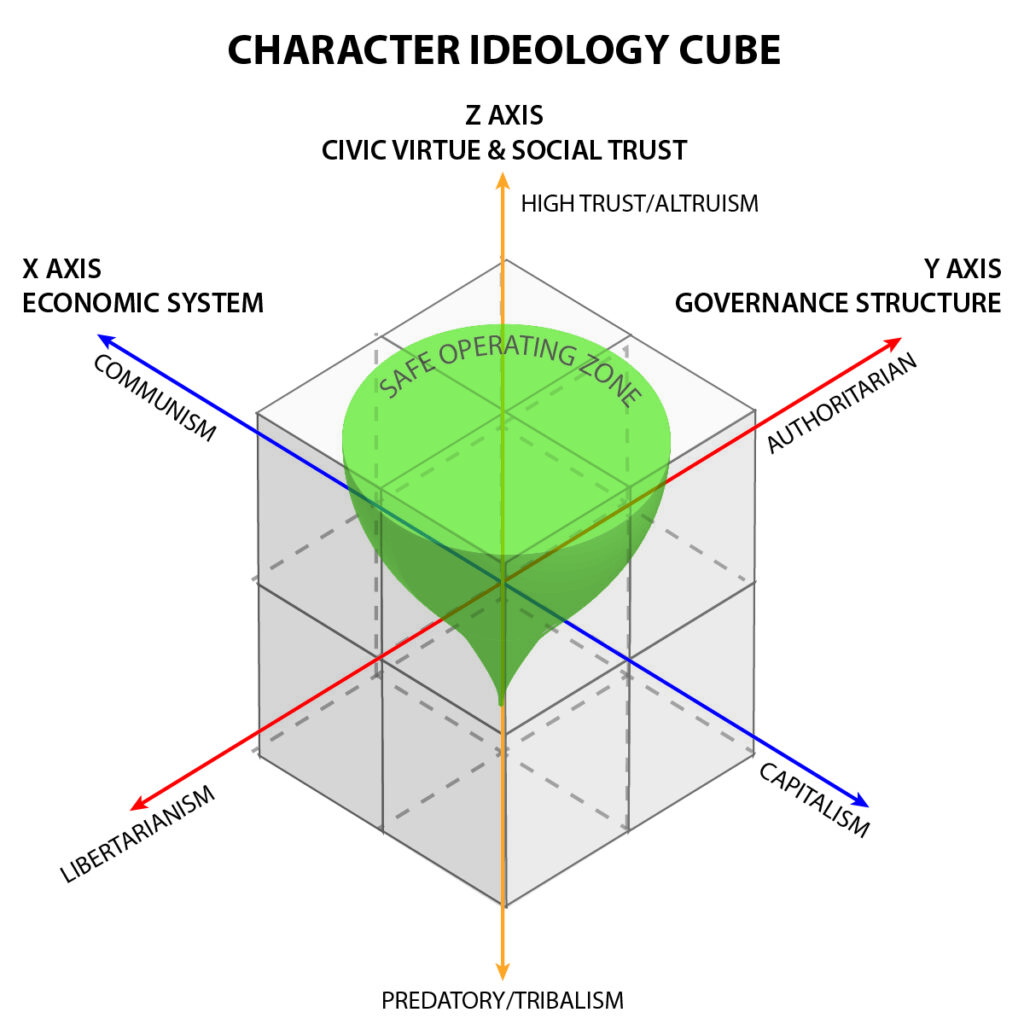
Traditional governance and management models evaluate organizations on a flat 2D grid—balancing economic orientation (X-Axis) against governance style (Y-Axis). With a 3 dimensional model and the Z Axis addition, four quadrants expands to eight octants. Virtuous Cubes are present when the Z value is positive, and Decay Cubes when the Z value is negative.
VIRTUOUS CUBES (+Z: High Civic Virtue / Trust / Benevolence)
Cube 1 – Stakeholder Commonwealth (+X, +Y, +Z): Market / Individual Liberty / High Virtue
Cube 2 – Cooperative Alliance (-X, +Y, +Z): Collective / Individual Liberty / High Virtue
Cube 3 – Paternalistic Stewardship (-X, -Y, +Z): Collective / State Authority / High Virtue
Cube 4 – Orderly Meritocracy (+X, -Y, +Z): Market / State Authority / High Virtue
DECAY CUBES (-Z: Predatory Greed / Tribalism / Distrust)
Cube 5 – Anarcho-Plutocracy (+X, +Y, -Z): Market / Individual Liberty / Low Virtue
Cube 6 – Tribal Anarchy (-X, +Y, -Z): Collective / Individual Liberty / Low Virtue
Cube 7 – Totalitarian Tyranny (-X, -Y, -Z): Collective / State Authority / Low Virtue
Cube 8 – Kleptocratic Autocracy (+X, -Y, -Z): Market / State Authority / Low Virtue
The Virtuous Cone Within The Character Ideology Cube™
The Traditional X and Y-Axis
The X-Axis maps traditional economic mechanics, resource allocations, incentive alignment, and market dynamics. Evaluates whether a community, organization or system operates on free-market exchange or centralized redistributive models.
The Y-Axis measures operational authority, regulatory friction, decision rights, and individual agency. Charts the spectrum between decentralized self-governance and centralized institutional oversight.
The Z-Axis – Societal Trust & Virtue
The new Z-Axis quantifies institutional character, psychological safety, mutual goodwill, and epistemic integrity (Ethos, Sympatheia, Fides). High Z-values (Z value above +0.2) create the “Virtuous Cone” necessary for long-term stability.
None of these Axis are static. Orientations within both the Economic and Governance vectors will change over time and with changes to public sentiment. This is equally true of the Z value, where events and behaviors of citizens, institutions, and system operations will either increase the trust factor for participants or erode it.
The Virtuous Cone
The Z value is the primary stabilizing variable in political economy. It dictates the size of the “safe zone” plateau, regardless of whether that trust comes from secular civic institutions or religious/ideological fervor.
High Civic Trust (+Z): Wide Tolerable Band
At high levels of civic trust, moral consensus, and legitimacy, a society can tolerate wide ideological divergence on both X (economics) and Y (governance) without falling apart. A high-trust social contract absorbs economic debate and policy swings easily.
Low Civic Trust (−Z): The Funnel / Chute
As trust and moral baselines decay (moving down −Z), the “safe operating margin” shrinks rapidly. Ideological extremes that were manageable at +Z become existential threats at −Z. The cone tapers down into a narrow vortex—a gravity well where even minor ideological disputes pull the system into totalitarianism or civil collapse.
TIME AFFECT ON DYNAMIC AXES
EXAMPLE: THE UNITED STATES Z VALUE MOVEMENT 2000 – 2025
The United States has experienced a significant shift in its Z value while X and Y axis orientation has not changed nearly as much during the last 25 years. But with the erosion of Trust and Virtue metrics and a decline in Z value, the range of X and Y value considerations within the safe or stable cone is narrowly reduced. With continued acrimony and erosion of the Trust metric though, the United States is at risk of falling outside the stability of the cone, and resulting movements along the X and Y axis then become non-linear, far less predictable and significantly outsized in movement. Examples of this include increasing calls within the citizenry for shifting to a far more socialist economic orientation, scrapping of the United States Constitution as well as calls for radical defunding or eliminating of public safety institutions.